
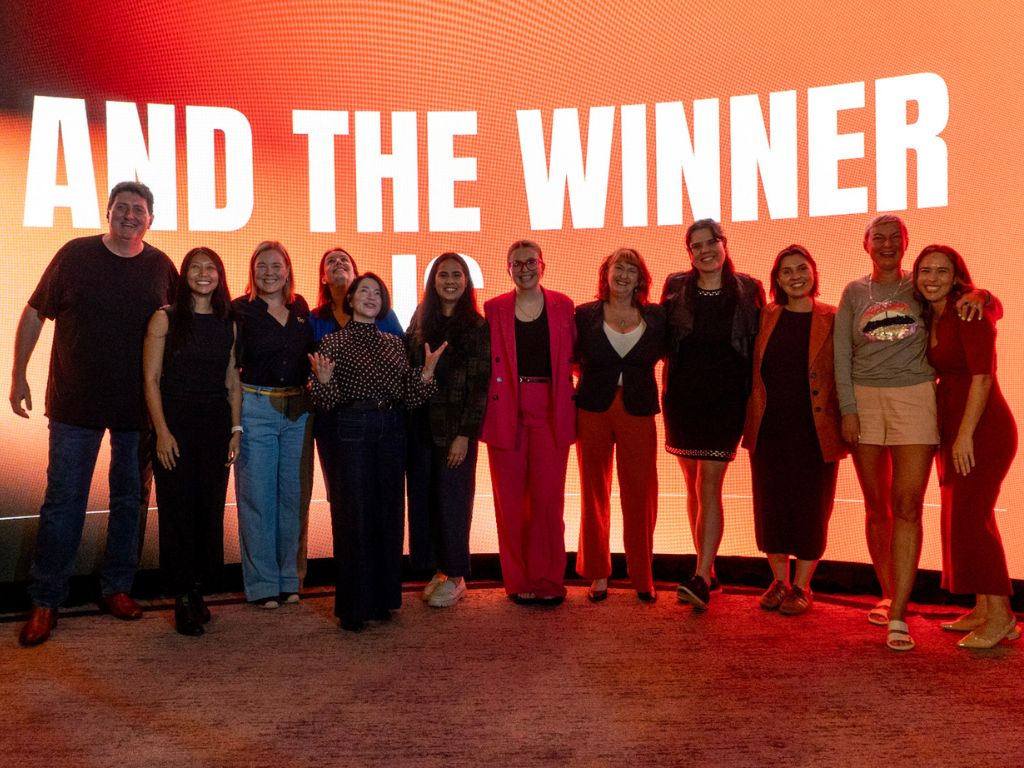
Quick Summary: Fishburners brought six female founders to the stage for a pitch night in Sydney – the opening event of their Ascent 2026 program.
Key Takeaways:
- Fishburners hosted a Female Founder Pitch Night in Sydney on 26 February as the opening event of their Ascent 2026 program
- Six female-led startups pitched on the night, spanning healthcare, construction, AI ethics, child safety, building technology, and home organisation
- Judges’ Choice went to Meher Bahl of Defectech, who is creating technology transforming how we diagnose and manage existing buildings
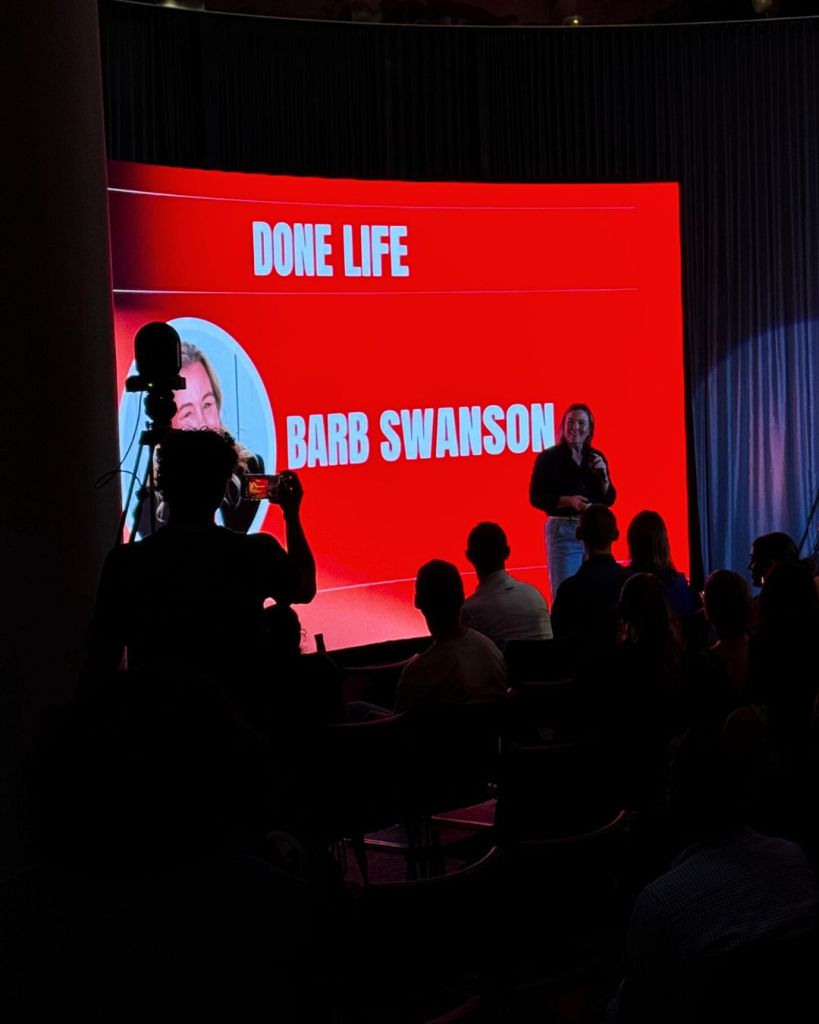
- People’s Choice went to Barb Swanson of Done, who is bringing enterprise-level systems to how families organise everyday life
- The judging panel included Jenny Rudd of Dispute Buddy, Richard Mulligan of FB Ventures, Joyce Lu of Five V Capital, and Sinead Fitzgerald of Vested Impact
- The night was MC’d by Veronica Mason, Founder of VRM Performance Coaching
- The night was held in partnership with Notion, Birchal, and FB Ventures
Fishburners has been running since 2011, supporting over 35,000 entrepreneurs and helping startups raise more than $1 billion in funding.
The Female Founder Pitch Night was the opening event of Ascent 2026 – their program built specifically to improve access to capital, networks, and outcomes for women founders.
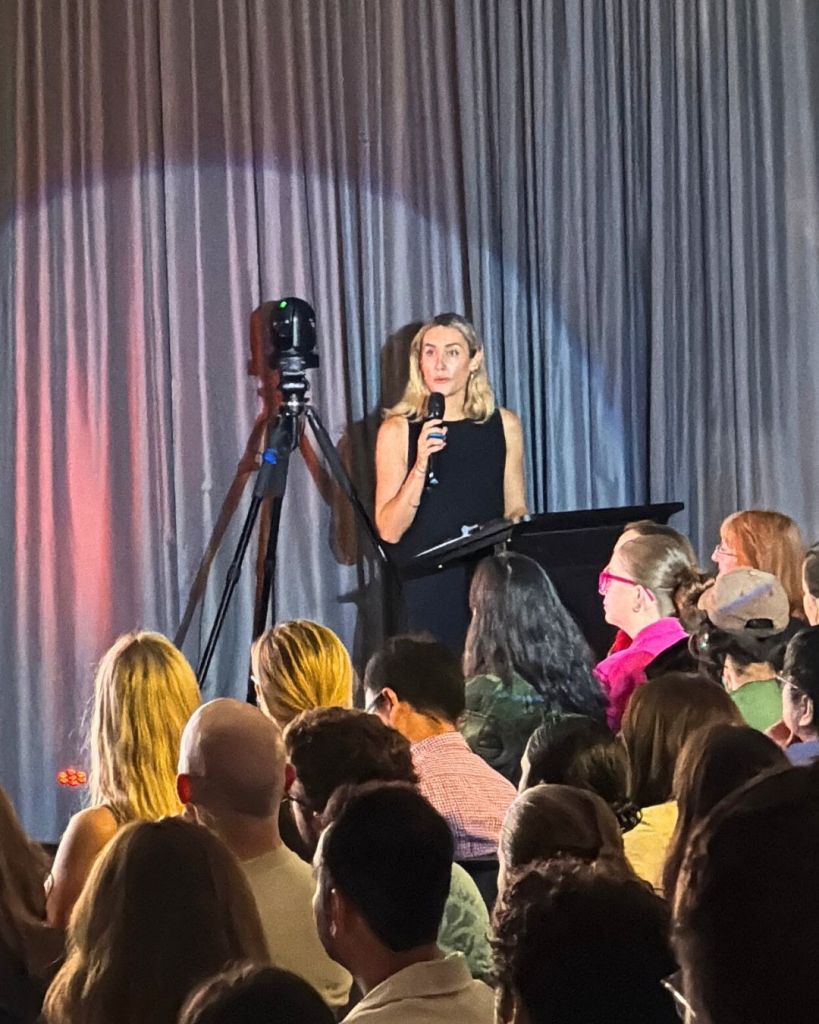
CEO Majella Campbell shared with White Rabbit Social: “When only a small fraction of venture capital flows to women-led startups, it’s not a statistic to observe, it’s a signal to act. Ascent is our action.
It’s about more than programming. It’s about access – to capital, to networks, to outcomes. We are committed to ensuring women founders are not just in the room, but resourced to win.”
Meet The Female Founders Who Took the Stage
The rules? A bell at 60 seconds, two bells at 90 to signal time. Judges questioned each founder post-pitch to keep them on their toes.
Six founders pitched across a broad range of sectors, many bringing the latest technological advancements to specific industry pain points.
Let’s jump in.
Meher Bahl Pitching Defectech
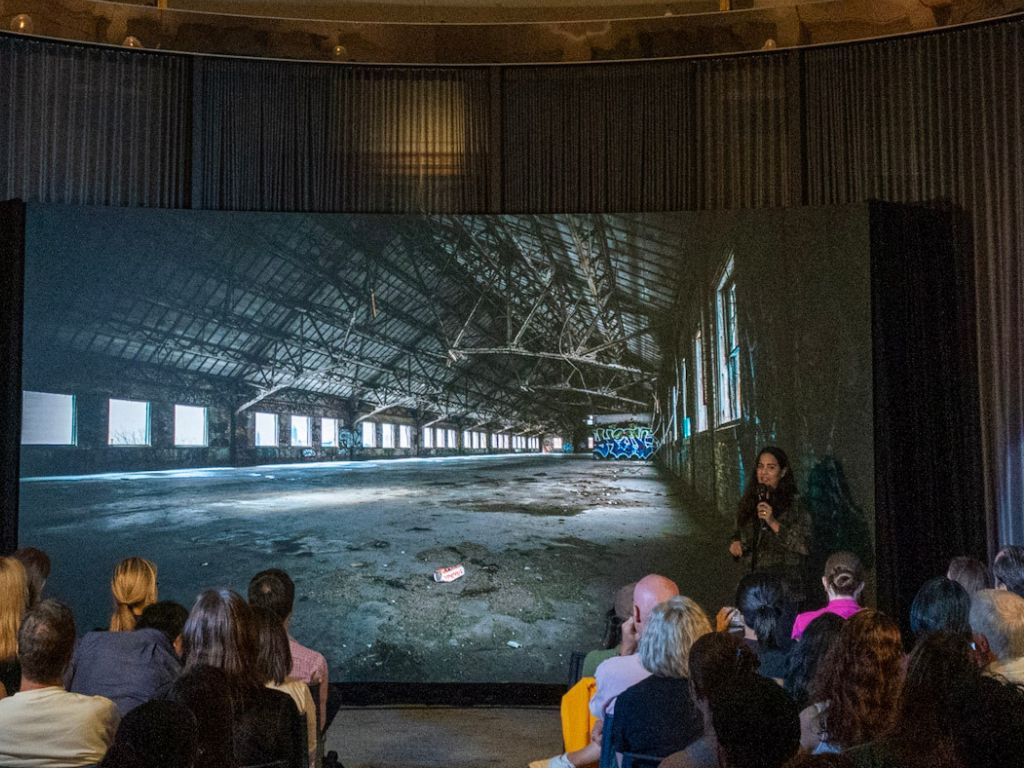
Building inspections are costly, often being reactive once signs of damage have appeared.
Thorough assessments rely on site visits from multiple stakeholders, too. Meher saw the same problem play out repeatedly – builders, inspectors, and conservation specialists walking through buildings that were deteriorating in ways that were preventable.
After more than a decade working across conservation and architecture, she began building a better way, focused on prevention and conservation.

The Pitch Details:
- Who she is: Meher is an award-winning architecture and conservation specialist with deep expertise in heritage buildings and digital modelling. Her work spans conservation practice and AI-assisted building assessment, and she is also the founder of Restore Conservation Services. She understands the lifecycle of buildings – and where current traditional inspection models fall short.
- What she’s building: Defectech is an AI-enabled building services tool that transforms how we diagnose and sustain existing structures. It captures both internal and external 3D imaging to create detailed digital twins, then applies AI-powered defect detection to identify issues in their early stages.
- How it works: The platform turns data-rich 3D models into actionable insights. By automating defect assessments and reporting, Defectech reduces the need for repeated site visits and complicated record keeping across a project. This means quicker, more accurate decision-making, which significantly reduces project cost.
- Why it matters: Around 80% of buildings that will exist in 2050 already stand today. Maintaining and sustainably managing existing building stock is one of the largest infrastructure challenges ahead – yet the sector remains painfully under-digitised.
- Judges’ choice: Applying scalable technology to a problem that has long relied on manual oversight deeply resonated with the judges, earning Meher the Judges’ Choice of the night. Jenny Rudd commented to Meher post-pitch “We need competent, experienced founders like you in this space”.
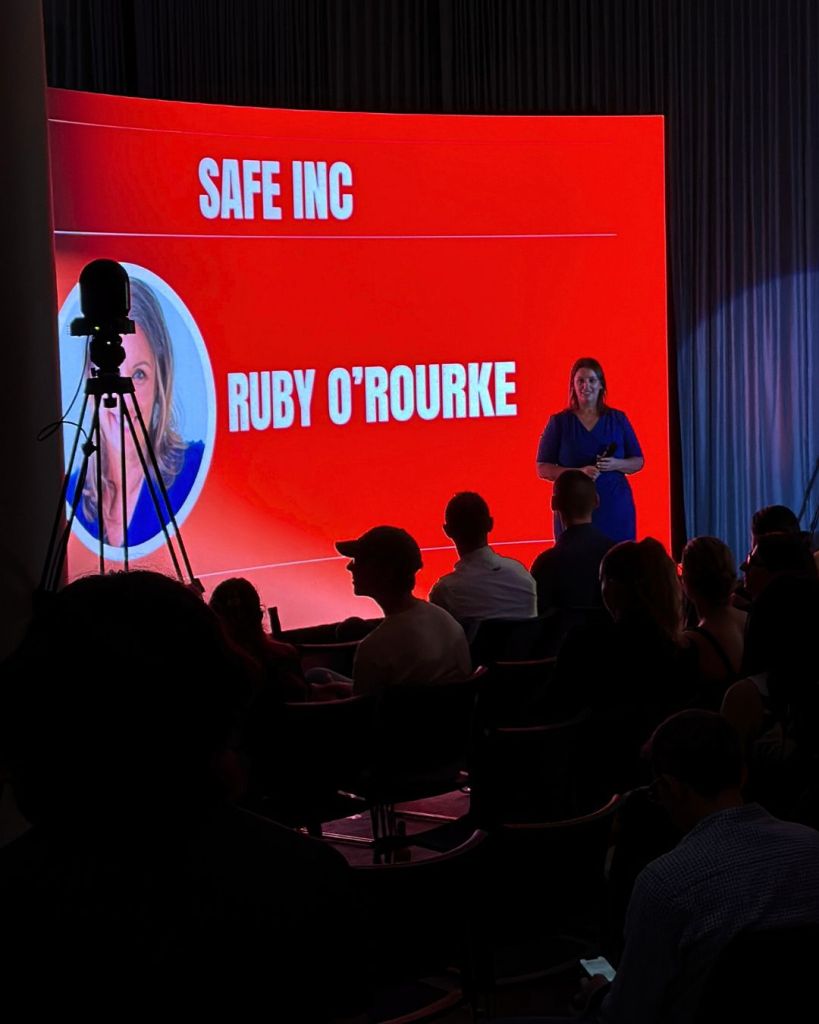
Ruby O’Rourke Pitching Safe Inc
Content note: This section discusses child exploitation and safety.
With each state and territory operating under different legislation, Australia’s child protection system remains fragmented.
Manual documentation is inconsistent, both in scope and the detail mandated reporters provide. With each process taking a different pathway, connecting incidents across the spaces a vulnerable child may pass through is rare, and that’s if they haven’t fallen through the cracks all together.
The lack of a unified national framework was found to directly contribute to inconsistent outcomes for victim-survivors, with many expressing the system is built to stall, being reactive rather than preventative.
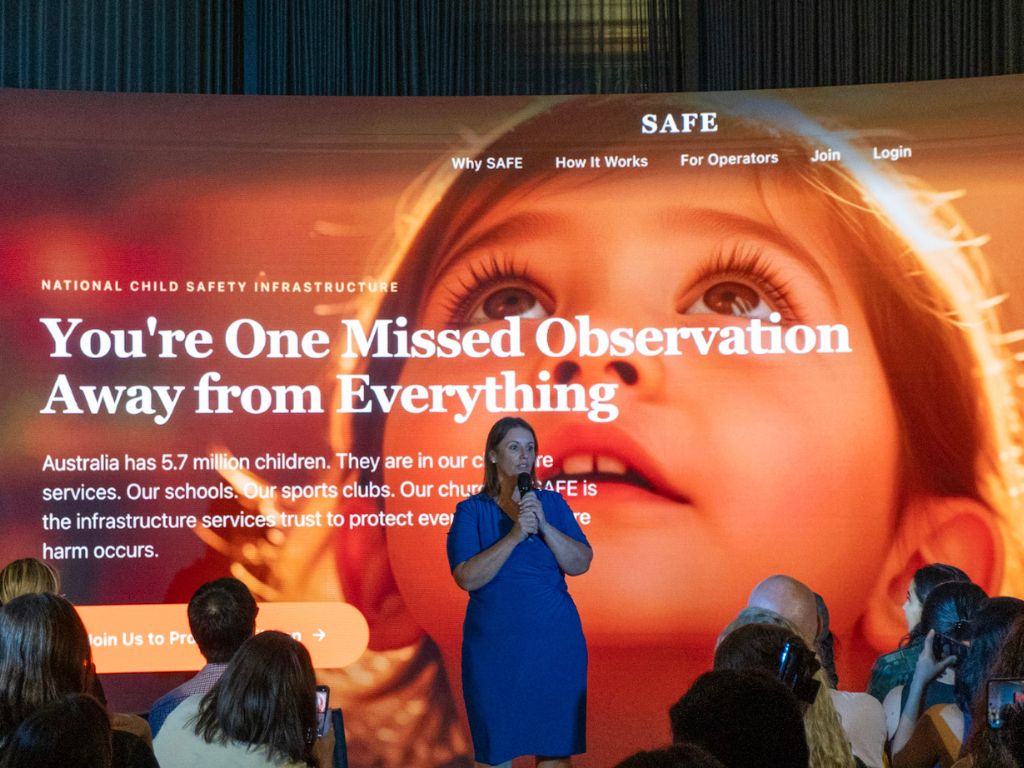
SAFE is a predator deterrent built on escalating the pattern detection of both the behavioural change of children, and the microsignals that might not meet the high threshold for an incident report.
Incubated over 12 years by Ruby O’Rourke, it has intervened in over 67,420 children’s reports with a 96.7% accuracy rating.
The Pitch Details:
- Who she is: Ruby is a nationally recognised child-safety reformer with a background spanning advocacy, policy, and systems reform. After surviving severe childhood harm, she dedicated her career to strengthening the frameworks designed to protect vulnerable children, working across government, NGO, and technology contexts.
- What she’s building: SAFE is a child safety platform designed to detect behavioural risk earlier and drive accountability across the spaces children navigate, approaching both child protection and predator deterrent as essential infrastructure.
- How it works: The platform removes common barriers to reporting in mandatory reporting environments (such as events deemed insignificant alone) and creates a structured pathway for concerns to be documented and escalated. By connecting signals across systems, SAFE reduces fragmentation and strengthens transparency in decision-making, helping professionals respond consistently and earlier.
- Why it matters: Ruby’s core belief is that children should not depend on luck to be safe. SAFE reframes prevention as a scalable, systemised responsibility – strengthening the foundations of protection before tragedy occurs.
Karen Van Den Engel of MMC Build

Australia’s housing problem is one too many Aussies know well.
Construction timelines are lengthy and skilled labour shortages compound the pressure.
Amid that strain, adoption of modern building methods remains sluggish while trying to keep up with demand.
The innovation exists, but without accessible, industry-ready tooling, it struggles to scale.
The Pitch Details:
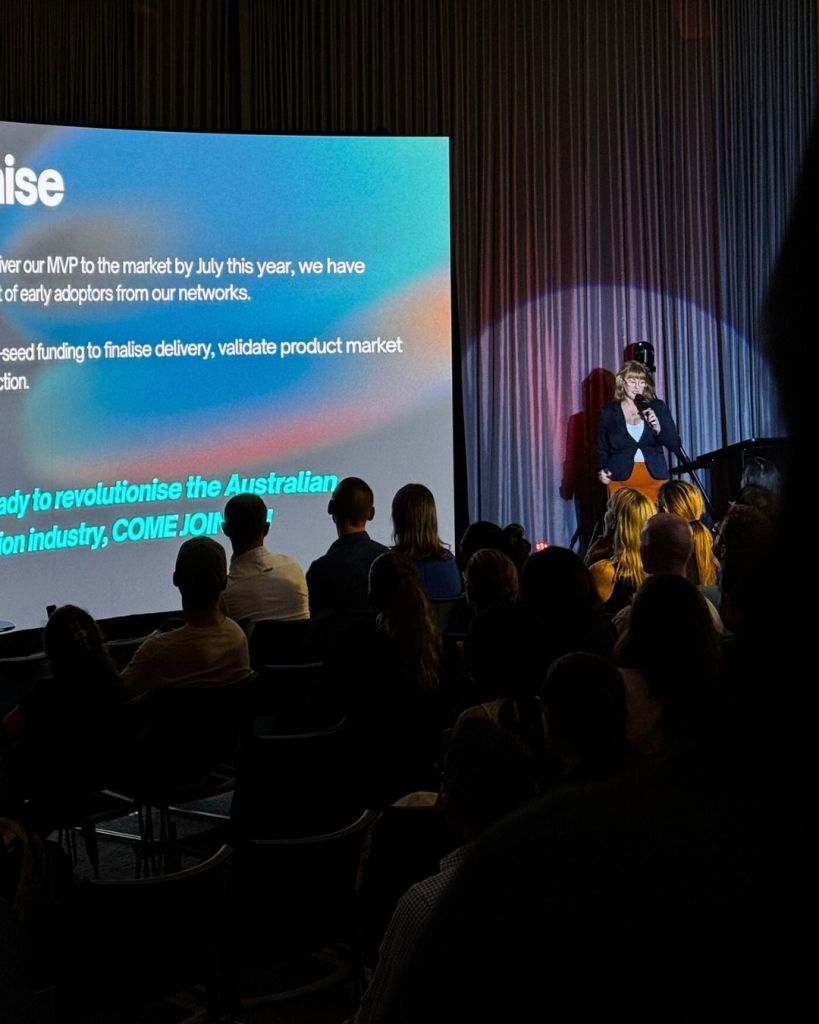
- Who she is: Karen brings over 20 years of experience across project management, property development, and construction delivery. Rather than working around the sector’s challenges, she is building a platform designed to help the industry move forward from within.
- What she’s building: MMC Build is Australia’s first AI-powered construction intelligence platform, purpose-built to support the adoption of modern methods of construction.
- How it works: The platform integrates five core modules: MMC Comply for AI-powered NCC compliance checking; MMC Build for design optimisation and cost modelling; MMC Quote for supplier-driven cost intelligence; MMC Direct, a verified directory of MMC-ready trades and suppliers; and MMC Train, a modern certification pathway for construction professionals. These modules work to form a connected ecosystem in one place, rather than a patchwork of disconnected, complicated tools.
- Why it matters: Construction remains one of the least digitised and most carbon-intensive industries globally. Built specifically for Australian regulations and construction environments, MMC Build is a practical response to one of the country’s most pressing infrastructure challenges.
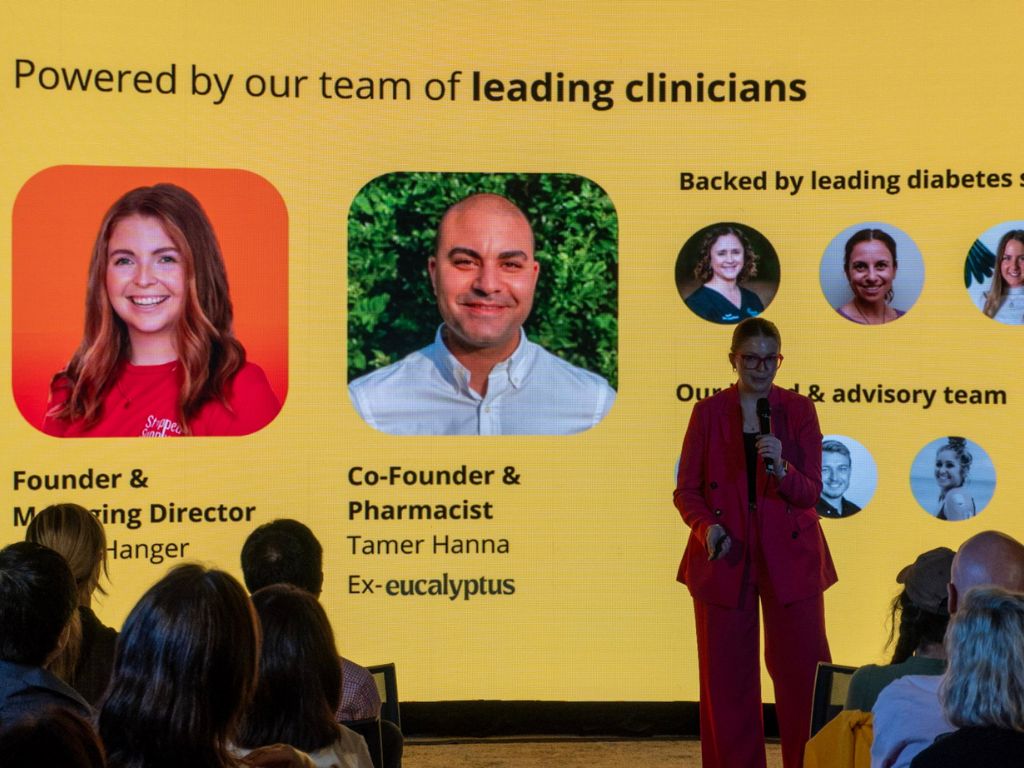
Ashley Hanger of Stripped Supply
Diabetes rates in Australia are rising, and the healthcare system is struggling to keep pace with the realities of chronic disease management.
For the 1.8 million Australians living with diabetes – and the 280 people diagnosed every day – the condition does not pause between appointments.
Scripts need renewing, supplies need reordering, and education needs to be communicated clearly at every stage of the disease. The responsibility of coordinating it all sits heavily on individuals and families.
The Pitch Details:
- Who she is: Ashley is a Marketing and Brand Strategist who founded Stripped Supply after watching her close friends and family struggle with type 1 diabetes.
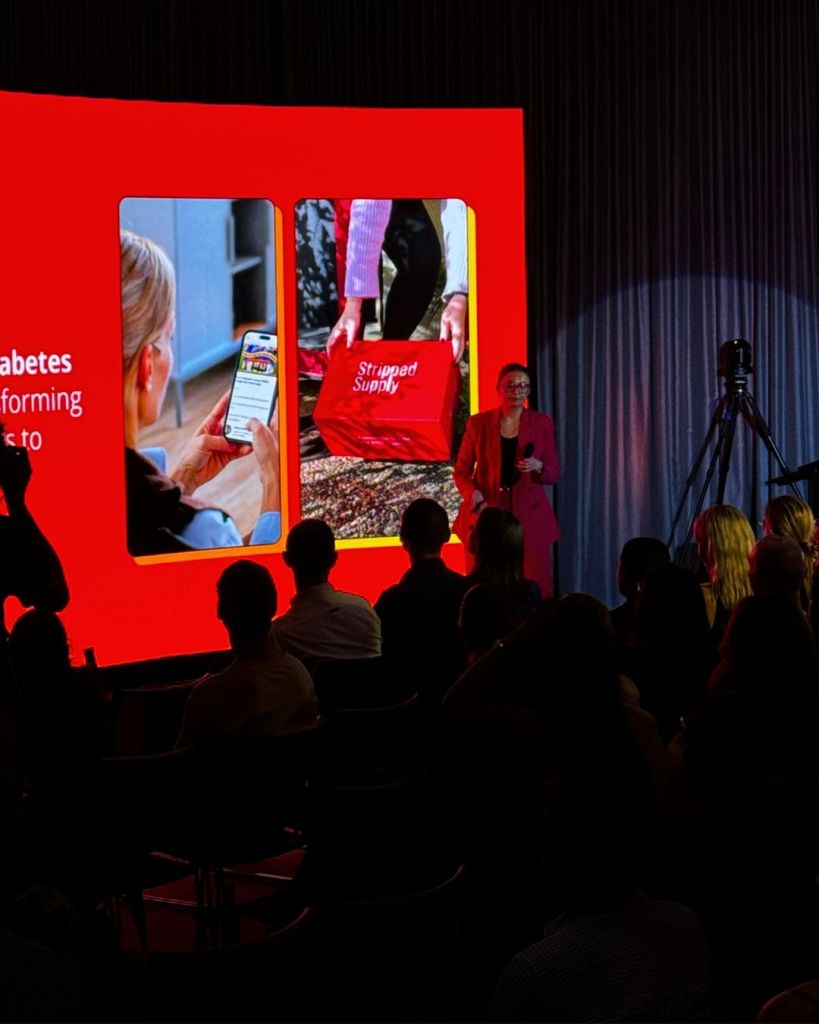
- What she’s building: Stripped Supply is Australia’s first diabetes subscription box – a set-and-forget service that automatically delivers custom boxes of life-saving medical supplies every 30 or 60 days to your door, anywhere in Australia.
- How it works: Patients never run out of supplies. Beyond delivery, the platform offers a clinician-authored education hub alongside their bite-sized learning modules, and a moderated community for peer-to-peer support.
- Why it matters: Ashley shared during her pitch that the problem isn’t just supply and access, but overwhelmingly the mental load of chronic disease management that takes focus away from health itself. Stripped Supply was created to take away the mental strain.
Kara Bombell and Katriel Healy of EthicAi Pitching Rosalind

AI adoption is no longer optional for most businesses. But how effectively that transition lands varies enormously, and the costs of getting it wrong – structural and human – are real.
Kara Bombell and Katriel Healy are building EthicAI to help businesses of all sizes bring in new technology without leaving culture or compliance behind. Rosalind is their first product, designed specifically for decision-making teams.
Acting as a diagnostic for leadership, Rosalind works by examining not just what people say, but how they say it, understanding how leaders function under pressure.
Analysing tone, bias markers, avoidance patterns, and overconfidence signals in written inputs helps surface dynamics that affect team performance, rather than narrowing in only on stated responses.
Rosalind then translates those insights into system design interventions, which can include structured conflict rituals to clearer decision rights, or even AI augmentation layers – all with helping teams reduce friction and strengthen alignment in mind.

The Pitch Details:
- Who they are: Kara is a strategic operations leader with over 15 years in senior executive roles, including COO at Digitas and Executive Director of Operations at Isobar. Katriel is a Chief People Officer and certified organisational coach with a decade of experience supporting boards and leadership teams through large-scale transformation.
- What they’re building: EthicAI specialises in AI ethics and organisational strategy, helping companies navigate AI adoption responsibly by aligning leadership capability, operating models (like team structure), and technology integration. Their suite also includes the Future Fit Diagnostic, bespoke workforce and operating model consulting, and leadership education.
- Why it matters: As AI reshapes work and the path forward becomes uncertain for anyone outside the technology space, the demand for structured, human-centred guidance that aligns with ethical practice is only growing. Rosalind is designed to help leadership teams navigate that complexity with integrity.
Barb Swanson Pitching Done. Life Management Platform

The administrative and logistical aspects of running a household (like planning a family calendar) can take 10-20 hours a week, yet it remains largely invisible in the world of productivity technology.
Done applies business productivity frameworks to the domestic space, creating a single source of truth for families.
Drawing on her experience scaling enterprise SaaS businesses, Barb has brought the same operational structure to the home.
And if nods from the crowd weren’t an indicator of how well the pitch landed, the votes sure were. Barb took the People’s Choice vote.
The Pitch Details:
- Who she is: Barb Swanson has a track record of scaling recurring revenue to over $150M ARR and leading commercial teams across nine countries and 18 cities. She moved to Australia from the US and has deep experience across enterprise SaaS and global operations.
- What she’s building: Done is a family life management platform combining AI-powered data capture, structured workflows, dashboards, and integrated support tools to remove the mental strain that has traditionally come with running a household.
- How it works: Flick it – forward anything important to your unique Done address. Click it – open your Done Action Board and assign it to a calendar, task list, or note in one tap. Done – nothing gets missed.
- Why it matters: Barb’s core insight is that the domestic load isn’t a lifestyle problem. She’s identified it as a systems gap, with homes operating with increasing complexity through lifestables without the infrastructure to match. Done was created to function like a chief of staff for family life.
Why This Night Matters
One pitch night doesn’t close the female founder funding gap in Australia, but it does put names and companies in front of people who have capital to help them deploy, working towards progress.
It signals to founders who aren’t in the room yet that there is a room, and they’re welcome in it.
Fishburners has been clear about where they’re putting their energy in 2026, and this night was a welcomed first move of the new year.
Know of any female founded startups we need to know about?
Let us know. We’re all ears.
WRS Team
Leave a Reply